Showing posts with label Global Warming. Show all posts

Saturday, 22 July 2023

The Reality of Climate Change


No photo description available.
Bumblebee on yellow Scabious flower
(Author's own photo)


Is Climate Change Serious?

From early in this century I started to notice people talking about global warming and the harm it would do to the world we know. It seemed hard to believe that the world around me was really in any danger and as our government didn't seem to feel any great urgency to act I wasn't unduly worried.

I watched the 2006 film "an Inconvenient Truth"fairly soon after it came out. It was shocking and worrying but I didn't know what I could do to change anything, so I forgot about it. Again, part of me assumed our politicians were working in our best interests, so were bound to do something about it if it was important.

Waking Up

This all changed early in 2019. People were talking about Extinction Rebellion, a group who were taking global warming seriously and were quoting climate scientists when explaining why they thought we all needed to take it seriously. Then David Attenborough presented a programme on the BBC called Climate Change: the Facts in which a number of eminent climate scientists explained what global warming and climate change were and how the high amount of fossil fuels were are burning is causing it. They also explained the serious consequences of us carrying on as normal.

If you haven't already seen it or haven't watched it recently I recommend you finding an hour to watch it when you aren't too tired, although I hope the message is serious enough to wake anyone up. It's crucial that we all understand what is happening. Sadly the lack of action in the last few years means we're going to find it extremely difficult to stay below 1.5ยบ C of global warming. The programme now seems a bit optimistic, but if we pull out all the stops we might still make it.

Climate Change the Facts on YouTube 


It's still available on the BBC as well.

https://www.bbc.co.uk/programmes/m00049b1

Wednesday, 19 July 2023

Eating to Save the Planet

A tasty veggie burrito with salad
in the Sustainability Centre Cafe


Consumers Choices Decide the Future

However bad global warming gets it's unlikely to destroy Planet Earth. When we talk about saving the planet we really mean saving human beings and the other lifeforms we share our planet with. The choices we make today, this year and for the rest of this decade are likely to decided whether our children inherit a warmer planet which is a bit more difficult to live on but has most of the animals they grew up with and on which most areas are still habitable, or whether they inherit a planet on which most lifeforms will soon die out. 

It's therefore vital that we choose wisely and carefully in order to give our children and grandchildren the best possible chance of a decent future without any more unnecessary suffering than is normal in the world as we know it

What we eat has an affect on our own health, but it also has an affect on the health of the climate and our environment, and so on the health of every living thing.  This means that the choices we make are crucial in shaping the future of life on our planet.

Eat Organic

If we choose some organic produce, not only are we consuming less potentially harmful chemicals, but the  fewer toxic chemicals there will be in the environment from spraying them onto conventionally grown crops and into the surrounding environment, and from rain washing those toxic chemicals into rivers and other water courses. This will help insects and all manner of other wildlife to have a better chance of survival, and we saw I my last blog how important wildlife, and particularly insects, are for a liveable climate and a thriving environment.

Moreover artificial fertilisers, weedkillers, fungicides and pesticides are all made from fossil fuels, so the more of them being used, the worse global warming with become.

You can buy organic fruit and veg in supermarkets or from veg box schemes, or you could grow your own.

Less Meat

If we eat less meat, fewer forests will need to be chopped down to grow grass for grazing. 

We need more farms like Racy Ghyll Farm, run by James Rebanks and his family the Lake District and other people like them, who sometimes call themselves regenerative farmers. They are not intensive farmers. Rebanks moves his stock around regularly so that no area of pasture is overgrazed allowing nature to thrive on his farm. He has also restored hedgerows which had been ripped out when larger fields with room for large farm machinery were the fashion. This more nature friendly form of farming produces less meat than if all the fields were being grazed to the maximum and supplementary feeding was implemented to make up for any shortfall in nutrition, but it's so much better for wildlife and the environment and produces far fewer greenhouse gases than if it were dependent on machinery, artificial fertilisers, pesticides and herbicides. Healthy grassland absorbs more CO2 than overgrazed pasture. A more natural diet with a wider range of fodder plants could even result in better digestion for the livestock and less methane production. 

Moreover, large, intensive farms produce vast quantities of slurry, which can easily wash into rivers adding to the problems caused by the excessive amount of untreated sewage currently pouring into them. This increases the risk of diseases spreading to humans, other mammals, birds, insects and all other wildlife. I understand that it's thought possible that industrial scale poultry farms have helped to spread bird flu. Slurry finding its way into rivers can result in people who swim in them picking up diseases such as E.coli. 

More Food from Plants

If we want to be healthier we are encouraged to eat more vegetables and fruit and other food from plants such as beans, peas and lentils, nuts and grains. Eating less meat also helps to reduce climate change and keep our environment healthier, so basing a lot of our meals on vegetables, pulses, grains and nuts benefits everyone except those with intensive livestock farms. Cashews are great in stir fries and some curries. There are also lots of delicious curries, stews and soups using pulses instead of meat and fish.

Eating less meat doesn't mean eating no meat. You can have beans with a little bit of beef in chilli con carne or you can enjoy a meat free, three bean chilli, which is just as tasty in my opinion, and have the occasional meat based meal. The same applies to everything else. You don't have to become a vegan to make a difference. If everyone in the world ate half the amount of meat they do at the moment, then half the land used to raise livestock currently could be returned to nature and no more virgin forest or ancient woodlands or meadows would need to be destroyed for pasture or to build industrial scale farm units on.

Eat Pulses to Save Money

Eating pulses like peas, chickpeas, beans and lentils is usually cheaper than eating meat. To save money my mum would regularly make lentil soup, especially in the cooler months. Dhals and chilli made with beans but not meat are also cheap and easy to make if you prefer your food on the spicy side. By eating cheaper pulses some of the time you will be able to choose higher welfare meat raised in more environmentally friendly ways when you do eat meat.

So it's worth experimenting with some meat free meals for your health and the health of the planet, and maybe even for the health of your bank balance. What's your favourite meat free meal? Let us know in the comments


Tuesday, 18 July 2023

Helping Insects Helps Us All

Painted Lady Butterfly on Hidcote Pink Penstemon
in author's garden, August 2021

Humans Need Nature

Many plants and animals are struggling because of climate change.  Some are in danger of going extinct, yet we all depend on them to help us stop climate change getting worse.

Plants have a central role in regulating our climate, which is why we need large numbers of many different plants to mitigate global warming and keep our environment healthy.  All plants absorb CO2, not just trees. 

The destruction of the Earth’s vegetation, by felling forests,  draining wet lands, building on scrub and grassland etc is making global warming worse. If we don't stop the destruction we will suffer even greater climate change than we are already. All kinds of animals have helped to create these landscapes and keep them healthy. Insects alone play a crucial role.

We Need Insects

‘If we and the rest of the back-boned animals were to disappear overnight, the rest of the world would get on pretty well. But if the invertebrates were to disappear, the world’s ecosystems would collapse.’ -  Sir David Attenborough

Almost 90% of the world's wild plants depend on animal pollination as do 75% of the most important crops globally. 

Over 100,000 invertebrates, including ants, bees, butterflies, beetles, flies, moths and wasps, along with more than a thousand mammals, birds, reptiles, and amphibians take on the job of pollinating plants. This biodiverse group of wildlife buzzes, flutters, and creeps from plant to plant, dining on protein-rich pollen and high-energy nectar. As they move, they transport and deposit pollen, fertilizing plants and allowing those plants to reproduce.

If we destroy insects and other invertebrates by destroying their habitats and poisoning them with pesticides, weedkillers and any other toxic chemicals they won't be able to keep the flowers that depend on them alive. It will also make it difficult to grow many crops. 

Birds, bats and many other animals depend on invertebrates for food. This is another reason why there needs to be an abundant supply. All life depends on all other life. If too many creatures go extinct we will all start to feel the affects.  

This is why we need sweeping reforms of how all land is managed, from large farms and estates to local parks and roadside verges. Until that happens all ordinary individuals can change is what happens in our gardens or any other outdoor space we manage, even if it's only a window box.

Giving Back to Wildlife

You might have heard of No Mow May. The idea behind this initiative from Plantlife is to encourage as many people as possible to leave a suitable area of grass to grow long, preferably all Summer, to allow wildflowers to grow and set seed, but also to enable insects and other animals which live in long grass, and wildflower meadows to thrive. When we are able to do this in part of our gardens, we are helping to replace the meadows and grasslands, which have been destroyed to make way for human "progress" over the last centuries. Our own houses might well have been built on them. 

My parents always bought new houses, so all the homes I inhabited as a child were probably built on natural or semi-natural spaces. The house I have returned to live in was built on erstwhile strawberry fields, but before that it might have been meadow or more likely woodland as there was a small copse nearby when I was growing up, now mostly built on. Many of the fields of my childhood have been built on too, some very recently. A growing population does need somewhere to live, but it would be good if all of us could give something back to help nature, which is why I've been letting my lawn grow long and doing other things to help pollinators.

In my last garden I finally persuaded my husband to stop using weedkillers and pesticides after living in the house for ten years. We noticed the difference within a year or two. There were a lot more birds, bees ad butterflies in the garden and grasshoppers became noticeable in the grass. More recently we started letting part of the lawn grow long there and stopped pulling out all the weeds. During lockdown I noticed shield bugs on the garlic mustard. Some were hawthorn shield bugs, presumably attracted by the hawthorn in our established hedge, planted by previous owners. I also started noticing the different types of hoverflies and native bees.

Pollinators are very important insects, so here a some suggestions for how we can help them:

How to Help Pollinators

  1. Leave some grass to grow long over the Summer, if possible.
  2. Don't use pesticides or herbicides, both of which can kill insects & other invertebrates and are very probably harmful to humans, pets and other animals too.
  3. Grow different types of flowers, some flat shapes like Daisies and Verbena bonariensus, bell shapes, tube shapes like Penstemons, Foxgloves and Fuchsia, spikes like Lavender, Nepeta and Salvias etc. Different insects are different sizes and have different types of tongues.
  4. If you don't have a garden you could grow smaller varieties in a window box or pot.
  5. Deadhead flowers, mulch with organic compost, and water well to keep the plants healthy and flowering for longer.
  6. Try to provide flowers from early Spring through to late Autumn.
  7. Leave corners of your garden to provide habitats.
  8. Buy peat Free Compost. Peat bogs are home to many special animals and plants, including the Large Heath butterfly, which is declining across Europe. There are now good alternatives to peat available from garden centres.
  9. Join in the Great Big Butterfly Count, an event organised by the Butterfly Conservation Trust which is happening now until the 6th August this year. It happens around the same time every year to monitor the state of the UK's declining butterfly population.
Are you doing some of these things already? Perhaps you'd like to pass on some tips. What else can we do to help pollinators and other insects? Let us know in the comments.


Friday, 14 July 2023

Global Warming in a Nutshell


An illustration of how greenhouse gases warm the Earth
(source unknown)

Some basic facts about Global Warming, the phenomenon causing Climate Change:

Global Warming has come about  because human beings have been pumping more and more Greenhouse Gases (GHGs) into the atmosphere. People burning fossil fuels like gas, coal, oil, diesel and petrol have been responsible for the increase in GHGs, which scientists tell us has been happening since the Industrial Revolution.


The Purpose of Greenhouse Gases

The temperature of the planet we live on is determined by the balance between the energy from the Sun and how much of that energy is lost into Space. The remaining energy is absorbed by both the land and ocean.

This process warms up both the land and the seas, which then radiate their acquired warmth as long-wave infrared or ‘heat’ radiation. This effect has been measured in the atmosphere and can be reproduced time and time again in the laboratory. We need this greenhouse effect because without it, the Earth would be at least 35 ° Celsius colder, making the average temperature in the tropics about -10 ° C. 

So, in a nutshell, without greenhouse gases the Earth would be too cold for very much to live on, polar bears would live in the tropics and the rest of the planet would be largely uninhabitable. However, you can have too much of a good thing.


Too Much Carbon in the Atmosphere

As snow falls, it is light and fluffy and contains a lot of air. When this snow is slowly compacted to form ice, some of this air is trapped. By extracting these air bubbles trapped in the ancient ice, scientists can measure the percentage of GHGs that were present in the past atmosphere.

Scientists have drilled over two miles down into both the Greenland and Antarctic ice sheets, which has enabled them to reconstruct the amount of GHGs that have been generated in the atmosphere over the last half a million years. Tests on these ice cores reveal that levels of greenhouse gases (GHGs) have gone up and down over the Earth's history, but they have been fairly constant for the past few thousand years. Global average temperatures have stayed fairly constant over that time as well, until recently.


What Is Causing Global Warming?

Global Warming has come about because human beings have been pumping more and more Greenhouse Gases (GHGs) into the atmosphere. People burning fossil fuels like gas, coal, oil, diesel and petrol have been responsible for the increase in GHGs, which scientists tell us has been happening since the Industrial Revolution

Gases in the Earth's atmosphere such as water vapour, carbon dioxide (CO2), methane (CH4), and nitrous oxide are known as greenhouse gases (GHGs) because they warm the Earth's atmosphere by absorbing some of the long-wave radiation from the sun. 

One of the ways in which we know that atmospheric CO2 is important in controlling global climate is through the study of what the Earth's climate has been like in the past. Evidence for past variations in greenhouse gases and temperatures come from ice cores drilled in both Antarctica and Greenland.

For more than 200 years, since the beginning of the Industrial Revolution people in Europe have been burning fossil fuels like oil, coal which were deposited hundreds of millions years ago. Burning these  releases the carbon back into the atmosphere as CO2 and methane (CH4), increasing the ‘greenhouse effect’ and raising the the Earth's temperature.

In effect we are burning fossilised sunlight and this has increased the concentration of atmospheric carbon dioxide (CO2). This human activity is increasing the greenhouse effect and warming the Earth more than is desirable. So too much carbon in our atmosphere is causing the overall temperature of our planet to rise. If this keeps happening we could end up as toast! 

In the last century industrialisation has grown all over the world so that more and more fossil fuels are being burned to keep up with the demand for production. Trees and plants absorb some of the CO2 in the atmosphere, so the clearing of land for agriculture, industry, house building and other human activities has also increased concentrations of greenhouse gases.

If you want to learn more about Global Warming and Climate Change the NASA website explains it well here.

Climate Change and What We Can Do About it.


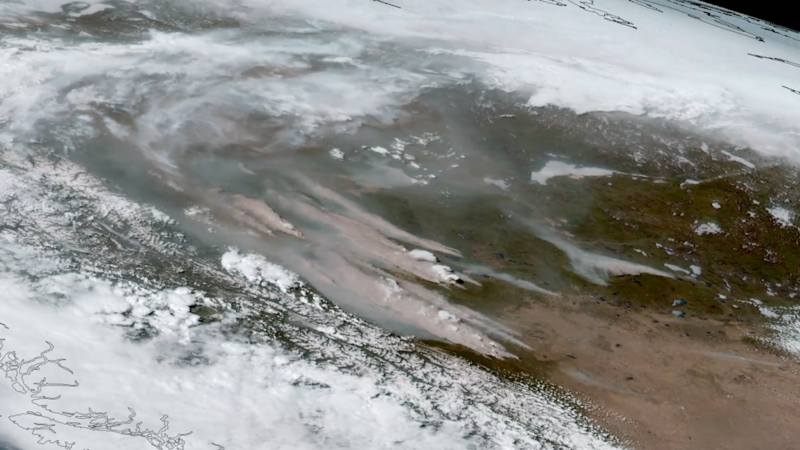
2023 Canadian wildfires - Wikipedia

GeoColor imagery showing the smoke from wildfires raging in western Canada. In early May 2023 

Severe flooding in various parts of the world such as India, Japan and Spain is being reported with alarming frequency. At the same time we're hearing about unusually hot heatwaves and droughts all over the world. A country can be in the midst of a lengthy drought one day and then suddenly be inundated by torrential rain which causes flash floods the next. Moreover wildfires seem to be more frequent in many parts of the world and some of them are hard to control.

This is not normal weather. This is a serious cause for concern.

Why is this happening and can we do anything to stop it?

Climate scientists are pretty sure why it's happening. All the evidence points to the greenhouse effect of certain gases. When these Greenhouse Gases collect in the Earth's atmosphere they make the whole of our planet warmer, which is why the affect is called Global Warming. Global Warming changes the Earth's climate. This changed climate makes weather in any given area more likely to be extreme and unpredictable.

We might not be able to stop it entirely but if we do nothing it's likely to get worse and worse.

If we all cut our greenhouse gas emissions and transition to renewable energy and find ways to use less energy as quickly as possible we might be able to stop things from getting too bad.

To do this we all need to pull together as if our lives depend on it. It's hard to predict who will be affected or when, but it's certain that many lives will depend on our efforts and no longer just those living nearest to the Equator.

Welcome to my new blog and thank you for reading this far. 

In future posts I shall explore what is happening and what we can do about it. 

After reading about both the problem and possible solutions over the last four years I shall explain things as best I can in ways that are fairly easy to understand with links to more information when appropriate.

 If you've chosen to read this blog perhaps you've already read a lot about it all too so it might not tell you anything new, but you might know someone who would find it helpful, in which case please share. It's important that as many people as possible understand what is happening and what needs to be done to turn the situation around. 

However, interacting with others who can support, encourage and inspire us is also very helpful.